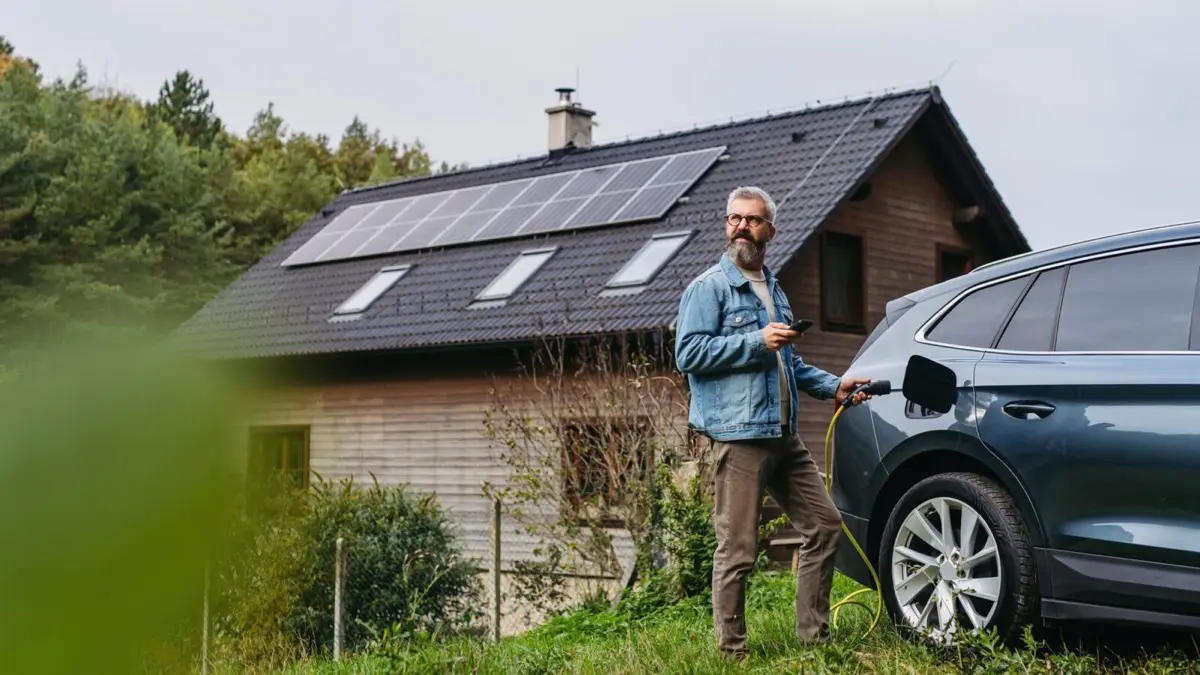
- Expect $1,250 to $2,200 all-in for a typical garage install in Clark County: a $450 to $700 connected charger plus $800 to $1,500 of licensed electrical work. Long runs and panel upgrades cost more.
- Clark Public Utilities pays a $500 rebate on a new, ENERGY STAR, Wi-Fi connected Level 2 charger from its qualified products list. Two per household, paperwork due within two years of purchase.
- The rebate goes to the utility account holder at the address. If your tenant holds the electric account, that is the tenant, not you. Install during a vacancy, or agree the handling with the tenant in writing.
- The federal 30C charger tax credit expired June 30, 2026. Any article still promising 30 percent back from the IRS is out of date.
- Permits are mandatory. City of Vancouver inside city limits, Washington L&I everywhere else in the county. Your electrician pulls it.
- No Washington law forces a rental-house landlord to allow or provide charging. The right-to-charge statutes cover condos and HOAs. For a house, the lease decides, so write an addendum.
A few years ago, "Does it have EV charging?" was a rare question at a showing. In 2026 it comes up regularly, and in neighborhoods like Felida, Camas, and Salmon Creek it is often one of the first questions after the rent. In 2024, roughly one in five new vehicles registered in Clark County was electric or plug-in, according to The Columbian, and Clark Public Utilities counted more than 18,000 registered EVs in the county as of July 2026. Those drivers rent houses too, and every one of them needs somewhere to plug in overnight.
So the owner question is no longer whether tenants want a charger. It is whether adding one to a rental makes financial sense, how to capture the local rebate without tripping over the fine print, and how to write the lease so the charger is an asset instead of a liability. This guide covers all three for a single-family or small multifamily rental in Vancouver and Clark County.
What a Level 2 Install Costs in Vancouver and Clark County
Skip Level 1. A standard 120-volt outlet adds four or five miles of range per hour, which is fine for a plug-in hybrid and useless for a commuter with a full battery-electric car. The upgrade renters actually value is Level 2: a 240-volt circuit, the same kind that feeds an electric dryer or range, delivering 25 to 40 miles of range per hour of charging.
The install has three cost components:
- The charger itself: $450 to $700. That range covers the connected, ENERGY STAR units that qualify for the utility rebate, including the Tesla Wall Connector, ChargePoint Home Flex, Wallbox Pulsar Plus, Emporia, and Grizzl-E Smart. A bare-bones non-connected unit is cheaper but only earns a $100 rebate instead of $500, so the connected unit usually nets out cheaper.
- The electrical work: $800 to $1,500 for a typical attached garage. Local electricians quote in this band for a dedicated 40 to 60-amp circuit, GFCI protection where required, mounting, permit, and inspection, usually done in a single half-day visit. The number climbs with distance from the panel, a detached garage or carport that needs conduit or trenching, or an older 100-amp panel that cannot take another large load. A panel upgrade alone can add $2,000 or more, which is why some quotes land at $3,500.
- The permit: roughly $50 to $200 depending on jurisdiction and scope, and almost always included in the electrician's quote.
Two design decisions affect the bill. First, amperage. A 48-amp charger on a 60-amp breaker is the fastest home setup, but a 40-amp charger on a 50-amp breaker delivers nearly the same overnight result and is easier on an older panel. For a rental, 40 amps is plenty. Second, hardwired versus plug-in. A hardwired unit is cleaner, weather-rated for outdoor mounting, and stays with the house, which is what you want as an owner. A NEMA 14-50 outlet with a plug-in charger is cheaper and lets a tenant bring their own unit, but the charger can walk out the door at move-out. We hardwire.
The $500 Clark Public Utilities Rebate, and the Catch
Clark Public Utilities runs one of the better residential charger rebates in the state, and it is still funded as of this writing. The program terms are straightforward:
- $500 for the purchase and installation of a new Level 2 charger that is ENERGY STAR certified, "connected" (Wi-Fi enabled), and on the utility's qualified products list. The rebate cannot exceed the charger's purchase price before tax plus installation costs.
- $100 instead for a non-connected Level 2 charger, or for the purchase of a mobile connector that plugs into a 240-volt outlet.
- Maximum of two Level 2 rebates per household. Used or resold chargers do not qualify.
- Paperwork due within two years of the purchase date. You submit the one-page residential form with the purchase receipt and the installer's invoice to rebates@clarkpud.com or by mail.
Business customers of the utility get a parallel $500 per charger with no stated cap on quantity, and pre-approval is required for projects over ten units. That version is worth knowing about if you own a small multifamily building with a house meter in the company's name.
The Account-Holder Catch for Landlords
The residential form has to be signed by the Clark Public Utilities account holder for the installation address, and the signer also authorizes the utility to pull two years of billing and charging data for the account. In a typical single-family rental, the tenant set up the electric service in their own name at move-in. That makes the tenant the account holder, and the tenant the person who signs and receives the rebate. Two practical ways to handle it: install the charger during a vacancy, while the electric service is temporarily in your name, and file the rebate before the next tenant moves in; or, if a tenant is already in place, have the tenant sign the form and agree in writing that the $500 comes back to you (or credits their rent). Either way, call the utility's rebates line at 360-992-3422 and describe your ownership situation before you buy the charger. Program terms change, and the utility's answer is the one that counts.
One more thing that has changed: the federal Section 30C tax credit that returned 30 percent of a home charger's cost up to $1,000 expired for equipment placed in service after June 30, 2026. Many installer websites and national blogs still advertise it. It is gone, and the utility rebate is now the only cash incentive on a Clark County residential install.
Permits: City of Vancouver Versus the Rest of the County
Every hardwired Level 2 charger and every new 240-volt circuit needs an electrical permit and a final inspection. Who issues it depends on the address:
- Inside Vancouver city limits: the City of Vancouver runs its own electrical permitting and inspection program. It is one of about two dozen Washington cities on L&I's list of jurisdictions that issue their own electrical permits, so L&I will not take a permit for a city address.
- Everywhere else in Clark County: Camas, Washougal, Battle Ground, Ridgefield, La Center, and all unincorporated areas (Hazel Dell, Salmon Creek, Felida, Orchards, Brush Prairie, Hockinson) go through the Washington State Department of Labor and Industries.
Your electrician pulls the permit and schedules the inspection as part of the job; make sure the quote says so. Keep the finalized permit with the property file. You will want it for the rebate paperwork, for your insurance carrier if there is ever a claim involving the circuit, and for the buyer's inspector when you eventually sell. An unpermitted 60-amp circuit is a cheap way to lose a sale.
Who Pays for the Electricity
At a single-family rental the answer is simple: the tenant, because the tenant already holds the electric account and pays for everything else on the meter. Our guide to who pays utilities in a Washington rental covers the general rules. The charger does not change them.
The cost is smaller than most owners expect. Clark Public Utilities charges a residential rate of 8.79 cents per kilowatt-hour plus a $19 monthly basic charge, about half the national average residential rate. A driver covering about 1,000 miles a month uses roughly 285 kilowatt-hours to do it, which is about $25 a month on the bill. A tenant who was paying $120 a month for gasoline will notice the difference, and it is a selling point worth putting in the listing.
Two situations need a lease term. If you pay the utilities, add a flat monthly EV charging fee so the cost does not land on you. If the charger is on a shared meter, such as a duplex where the garage circuit runs off the house panel, either submeter the charger (many connected units report exact kilowatt-hours in their app, which is good enough for a lease) or set a flat fee, and disclose the arrangement in writing before signing. Never let one tenant's driving quietly show up on another tenant's bill.
There is also a small perk to pass along: Clark Public Utilities pays EV drivers a $50 bill credit ($25 at enrollment, $25 at year end) for joining its managed charging pilot through the Optiwatt app, which shifts charging to off-peak hours. It works with most major EV brands and with ChargePoint and Wallbox chargers, enrollment is capped at 1,400 vehicles, and the pilot currently runs through the end of 2026, so tell your tenant about it at move-in rather than assuming it will still be there next year.
What to Put in the Lease
Washington's right-to-charge statutes apply to condominium and homeowner associations, which cannot flatly prohibit a unit owner from installing a charger in their assigned space. Nothing equivalent exists in the Residential Landlord-Tenant Act for a rental house, so the lease controls. Whether you install the charger or a tenant asks to, write it down. This belongs in the same document as your other lease addendums.
If you installed the charger
- It is a fixture and stays with the property. Say so, and list the make and model.
- Tenant use only, for the tenant's own vehicles. No charging for neighbors or for a fee.
- No modifications, no extension cords, no adapters that the manufacturer does not approve. A 240-volt extension cord across a garage floor is a fire and a lawsuit waiting to happen.
- Report faults promptly and do not attempt repairs. Treat it like the furnace.
- Electricity is the tenant's cost, or the flat fee if you pay utilities.
- Keep owner access to the app. Connected chargers let you set the maximum amperage and see faults remotely. Register the unit to an owner or manager account and give the tenant a user login, so settings survive turnover.
If a tenant asks to install one
- Written consent, at your discretion. Nothing in Washington's Residential Landlord-Tenant Act gives a tenant a right to alter the property, and RCW 59.18.130 makes the tenant liable for damaging or removing any part of the structure, so a standard lease requires written consent before any installation.
- Licensed electrician, permit, and inspection, with copies to you before the unit is energized.
- Ownership at move-out. Either the charger stays and becomes yours (the usual answer for a hardwired unit), or the tenant removes it and restores the wall and circuit at their cost. Pick one now.
- Renters insurance that covers the equipment and any damage it causes. Our guide to requiring renters insurance in Washington explains what you can ask for.
- Consider the rebate angle. A tenant who installs a qualifying charger can claim the $500 themselves, because they are the account holder, which makes a tenant-funded install cheaper than they expect.
Does It Pay Back?
Be honest with the math. After the rebate, a typical install nets out at $750 to $1,700. A $25 to $50 monthly premium at the next turnover recovers that in one to four years, which is a decent but not spectacular return on its own. The stronger case is what a charger does to leasing speed and retention. In its 2025 home-trends report, Zillow found EV chargers appearing in 34 percent more for-sale listings than a year earlier, and EV-driving applicants filter for the feature. An EV household that moves into a home with a charger has a real cost to leaving: the next place probably does not have one. Every month of vacancy you avoid and every renewal you win is worth more than the premium.
Three things to keep in mind when you price it:
- Reprice at turnover. Washington's HB 1217 caps rent increases for existing tenants, so an upgrade mid-lease does not let you jump the rent by the value of the charger. Our post on how much rent can go up in Washington has the current-year cap. The clean approach is to install during a vacancy, claim the rebate while the service is in your name, and list the home at the new rent.
- Depreciation, not a same-year deduction. A hardwired charger is a capital improvement to the property and is depreciated rather than expensed, although the de minimis safe harbor may let you expense the charger unit itself if it is invoiced separately under $2,500. Confirm with your CPA and see our rental property deductions checklist.
- Insurance. Tell your landlord policy carrier about the new circuit. It is rarely a premium change, but an undisclosed high-amperage install is the kind of thing an adjuster looks for after a garage fire.
Chargers That Qualify, and What We Specify
The utility's qualified products list runs to hundreds of models. For a rental we want four things: on the list, hardwired, 40 amps, and a connector every tenant can use. The models we see installed most often in Clark County:
- Tesla Wall Connector (Universal). Ships with a built-in adapter so it charges both Tesla and J1772 vehicles. Sleek, inexpensive, and on the list.
- ChargePoint Home Flex. The standard J1772 choice, adjustable amperage, strong app, and available in a NACS version for newer vehicles.
- Wallbox Pulsar Plus, Emporia, and Grizzl-E Smart. All qualify; all are solid. Grizzl-E is the rugged pick for an outdoor carport.
On the connector question: most non-Tesla EVs built before 2025 use the J1772 plug. Hyundai, Kia, and Ford began shipping models with the Tesla-style NACS port in 2025, GM followed for 2026, and the rest of the industry is moving the same way. A J1772 charger with a $50 NACS adapter, or a universal unit, covers both. Do not overthink it; the adapter is the tenant's to keep.
A Simple Install Checklist
- Confirm panel capacity and the distance from panel to parking spot. Get two written quotes that include permit and inspection.
- Pick a charger from the current Clark Public Utilities qualified products list, connected and ENERGY STAR. Buy it new and keep the receipt.
- Time the install for a vacancy if you can, with electric service in your name, and file the rebate form within days of the inspection.
- Register the charger to an owner or manager account; create the tenant login at move-in.
- Add the EV charging addendum to the lease. Mention the charger, the electricity, and the no-modifications rule.
- Put "Level 2 EV charger in garage" in the first line of the listing, with a photo. Mention the tenant's $50 managed-charging credit at the showing.
- File the permit, receipt, rebate confirmation, and charger serial number in the property record.
VPMG Handles the Upgrade, the Rebate, and the Lease
We coordinate the electrician, time the install for the turnover, file the utility paperwork, and add the charging addendum to our Washington-compliant lease, all inside our flat 8 percent fee with no markup on the electrical work. Call (360) 803-2002 or email info@vancouverpmg.com for a free rental consultation.
Frequently Asked Questions
How much does it cost to install a Level 2 EV charger at a rental home in Vancouver, WA?
Budget roughly $1,250 to $2,200 all-in for a typical garage install: $450 to $700 for a connected Level 2 charger that qualifies for the Clark Public Utilities rebate, plus $800 to $1,500 for a licensed electrician to run a dedicated 240-volt circuit, mount the unit, and pull the permit. A long wire run, a detached garage, or a panel that needs upgrading can push the electrical work to $3,500 or more. The $500 utility rebate comes off the top if the paperwork is done correctly.
Can a landlord get the $500 Clark Public Utilities EV charger rebate for a rental property?
The rebate is paid to the Clark Public Utilities customer at the installation address, and the form must be signed by that account holder. In a single-family rental where the tenant has the electric account in their name, the tenant is the account holder, not the owner. The cleanest path for an owner is to install the charger during a vacancy while the electric service is in the owner's name and submit the rebate then. If a tenant is in place, the tenant would sign the form and the two of you agree in writing on how the rebate is handled. Confirm your situation with the Clark Public Utilities rebates line at 360-992-3422 before you buy the charger.
Do I need a permit to install an EV charger in Clark County?
Yes. A hardwired Level 2 charger or a new 240-volt circuit requires an electrical permit and a final inspection. Inside Vancouver city limits, the City of Vancouver runs its own electrical permit program. Everywhere else in Clark County, including Camas, Washougal, Battle Ground, Ridgefield, La Center, and unincorporated areas, permits go through the Washington State Department of Labor and Industries. A licensed electrician normally pulls the permit as part of the job.
Is a Washington landlord required to let a tenant install an EV charger?
No. Washington's right-to-charge statutes apply to condominium and homeowner associations, which cannot flatly prohibit a unit owner from installing a charger in their own parking space. There is no equivalent statute in the Residential Landlord-Tenant Act for a rental house, so a tenant needs the landlord's written consent to install one. If you allow it, put the terms in a lease addendum: licensed electrician, permit, who owns the equipment, and what happens at move-out.
Who pays for the electricity an EV charger uses at a rental?
In a single-family rental where the tenant holds the electric account, the tenant pays, exactly as they do for the dryer or the furnace. At Clark Public Utilities' residential rate of 8.79 cents per kilowatt-hour, a driver covering about 1,000 miles a month adds roughly $25 to the bill. If the owner pays utilities, or the charger is on a shared meter at a duplex, the lease needs a flat monthly charging fee or a submeter so the cost is not absorbed by the owner or by a neighbor.
Does an EV charger increase rent or property value?
It is a marketing feature first and a rent premium second. Roughly one in five new vehicles registered in Clark County is now electric or plug-in, and the county passed 18,000 registered EVs in 2026, so a listing that says Level 2 charger in garage reaches a growing pool of renters who will filter for it. A modest premium of $25 to $50 a month at turnover is realistic in this market, but do not count on it to justify the install by itself; faster leasing and longer tenancies are the bigger financial effect. Under Washington's HB 1217 rent cap, the best time to reprice for the upgrade is at turnover, not mid-tenancy.
This article is general information for Clark County rental owners, not legal, tax, or electrical advice. Rebate amounts, the qualified products list, and program rules were checked against Clark Public Utilities' published materials in September 2026 and can change without notice; confirm current terms with the utility before purchasing. Cost ranges are typical local quotes, not bids. Consult a licensed electrician, your CPA, and a Washington attorney for your specific property.

Written by Avenir Gedarevich, Washington State Designated Broker (WA Managing Broker License #24033559) at VPMG Property Management in Vancouver, WA.